


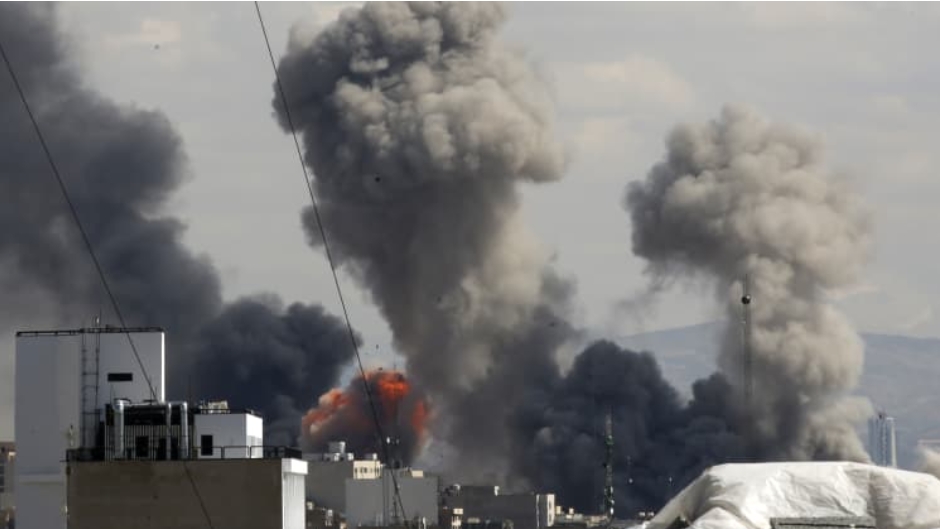


The State of Germany’s Economy: Crisis Dynamics, Structural Constraints, and Future Stabilization
Germany’s economic disposition is undergoing a profound stress test, one that contrasts sharply with its reputation as Europe’s industrial anchor. While historical success rested on manufacturing scale, export competitiveness, and affordable energy, today’s reality is defined by contraction rather than resilience. Former Greek finance minister Yanis Varoufakis warned in a November 2024 lecture in Berlin that Germany is facing “de-industrialization in real time,” citing a double-digit fall in industrial output. Data from Destatis confirm that industrial production declined by over 11 percent between 2023 and mid-2024, a drop widely reported by Financial Times and Reuters, signalling a structural rather than cyclical downturn.
Germany’s slowdown also destabilizes the broader European Union. As Le Monde observed in October 2024, the eurozone’s architecture depends on German export surpluses to offset deficits elsewhere. Weakening German demand raises risks for heavily indebted economies such as Italy and constrains fiscal space in France and Spain. At the same time, EU-level regulations on carbon pricing, supply-chain due diligence, and labour standards raise production costs for European firms. The European Central Bank faces a dilemma highlighted by ECB President Christine Lagarde in Frankfurt in 2024: tighter monetary policy curbs inflation but deepens stagnation, while looser policy risks eroding confidence in the euro.
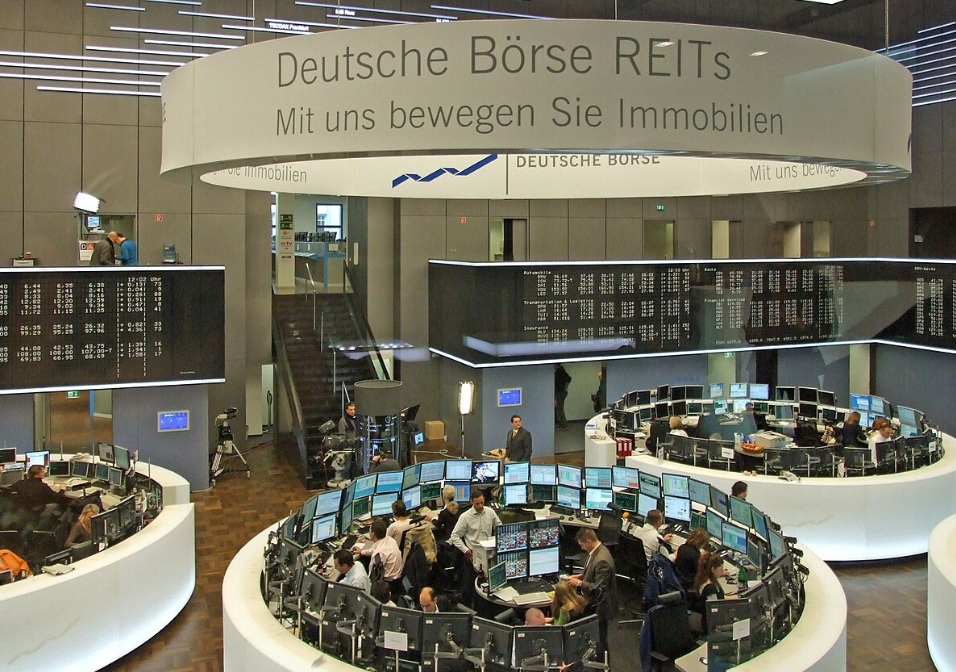
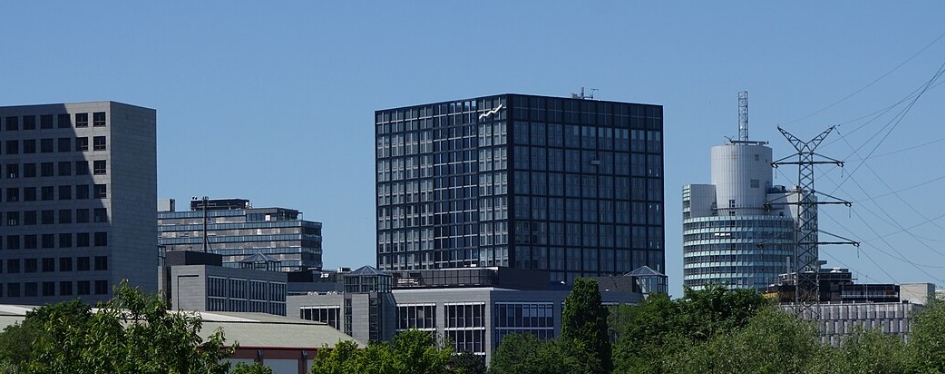
Deutsche Börse AG, the company behind Germany’s main stock exchange infrastructure, has its headquarters in Eschborn, just outside Frankfurt am Main.
At the core of Germany’s present challenge is energy policy. The permanent loss of Russian pipeline gas after the Ukraine war removed the low-cost foundation of German heavy industry. According to Bloomberg (February 2024), liquefied natural gas imports cost German firms roughly three times more than previous supply arrangements. Compounding this shock was the April 2023 shutdown of Germany’s last nuclear reactors, a decision criticized by the International Energy Agency for reducing grid stability during an energy crisis. Energy-intensive sectors such as steel, aluminium, and chemicals have since curtailed production, with BASF confirming in Ludwigshafen in 2024 that it is shifting major capacity to China and the United States.
Industrial relocation has accelerated these pressures. Volkswagen announced in September 2024 its first domestic factory closure since its founding, while BMW and Mercedes-Benz confirmed expanded investments in Mexico and Asia, as reported by Handelsblatt. These decisions reflect cost realities rather than short-term adjustments. German steel output has fallen by more than 30 percent since 2021, according to Eurofer, and aluminium smelting has nearly vanished. The consequence is a hollowing out of industrial ecosystems, where suppliers, logistics firms, and regional service economies collapse alongside anchor manufacturers.
Demographics magnify these economic strains. Germany’s birth rate has remained below replacement for five decades, and the Federal Statistical Office projects a shrinking workforce throughout the 2030s. The Economist noted in July 2024 that Germany now faces one of the steepest old-age dependency ratios in the OECD. Rising pension and healthcare costs are increasing the tax burden on workers, discouraging investment and accelerating skilled emigration. The German Institute for Economic Research reported in 2024 that net out-migration of university-educated Germans reached its highest level since reunification, reinforcing a cycle of declining productivity and fiscal stress.
Political consequences are already visible. Economic stagnation has fuelled voter dissatisfaction, particularly in eastern Germany, where the Alternative für Deutschland became the largest party in several 2024 state polls, according to Der Spiegel. Analysts at the German Council on Foreign Relations warn that sustained industrial decline undermines social cohesion and trust in centrist governance. Similar dynamics are emerging across Europe, where weak growth correlates with rising political fragmentation. History suggests that prolonged economic stress tends to radicalize electorates, especially when mainstream parties appear unable to address underlying structural problems.
Future stabilization requires pragmatic rather than ideological recalibration. Energy policy is central. Multiple economists cited by The Wall Street Journal in 2024 argue that extending or reintroducing nuclear capacity would provide reliable, low-carbon baseload power while renewables and storage mature. Parallel investment in grid infrastructure and diversified gas supply could stabilize prices. On demographics, Germany must align family policy, skilled immigration, and labour-market reform to expand its productive base. The OECD has repeatedly emphasized that integration outcomes, not migration volume alone, determine economic benefit.
Germany’s growth prospects ultimately depend on restoring competitiveness. Regulatory flexibility within the EU, targeted industrial policy, and incentives for domestic research and development are essential to prevent further capital flight. As Varoufakis argued in Athens in 2024, decline is not inevitable but politically chosen. Germany still retains advanced infrastructure, human capital, and institutional strength. Whether it translates these assets into renewed growth will shape not only national prosperity but the economic and political stability of Europe for decades to come.